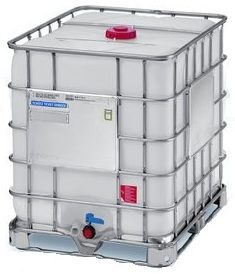
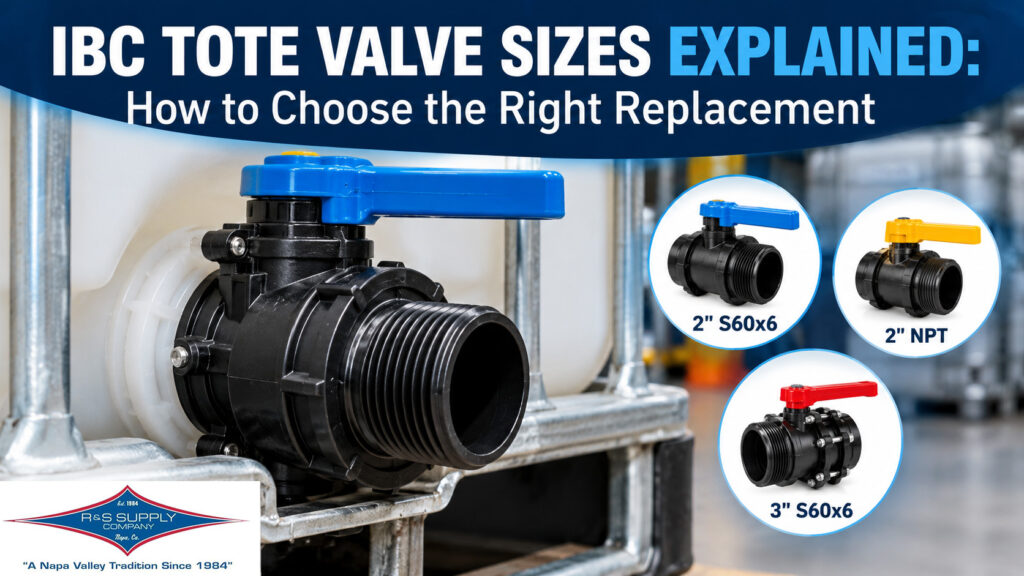
IBC totes are widely used to store and transport liquids in industries ranging from agriculture and food processing to chemical manufacturing and winemaking. They're durable, reusable in appropriate applications, and designed to make handling bulk liquids more convenient.
But when an IBC tote valve starts leaking, becomes damaged, or needs to be replaced, finding the correct replacement isn't always as simple as ordering another 2-inch valve.
Not all IBC tote valves are the same size, and even valves that look nearly identical may have different threads, connections, or sealing requirements.
A valve might have a 2-inch nominal outlet, but that doesn't necessarily mean it will fit your existing tote. The thread type, connection dimensions, valve design, and manufacturer specifications all play an important role.
In this guide, we'll explain common IBC tote valve sizes, how to identify different outlet connections, and what to check before purchasing a replacement.
What Size Valves Are Used on IBC Totes?
Many standard industrial IBC totes use valves with nominal outlet sizes of approximately 2 inches (DN50), while some containers use larger 3-inch (DN80) valve assemblies.
However, there's an important distinction between a valve's nominal size and its actual connection dimensions.
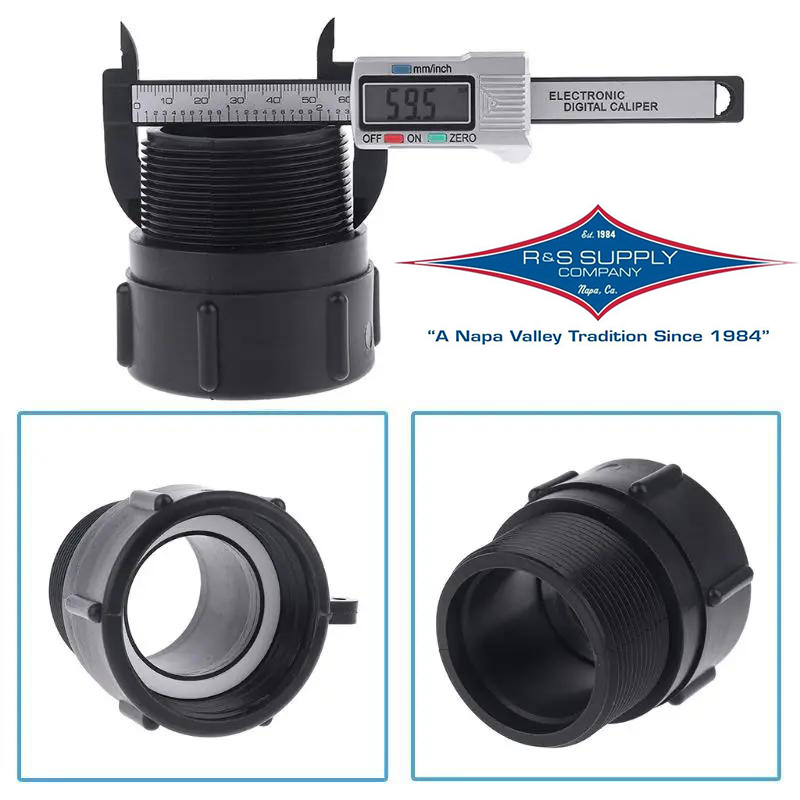
A 2-inch IBC valve doesn't necessarily have threads measuring exactly 2 inches across. In fact, one of the most common IBC outlet connections, S60x6, has an outside thread diameter of approximately 60 millimeters, or 2.36 inches.
Manufacturers also use different connection designs on the tank side of the valve and the discharge side where hoses or adapters attach.
Common IBC Valve Sizes at a Glance
| Valve or Connection | Typical Size | What to Know |
|---|---|---|
| DN50 / 2-inch valve | Nominal 50 mm | Common valve size on many IBC totes |
| DN80 / 3-inch valve | Nominal 80 mm | Used on some larger-discharge systems |
| S60x6 outlet | 60 mm diameter, 6 mm pitch | Common coarse-thread discharge connection |
| S100x8 outlet | Approximately 100 mm diameter, 8 mm pitch | Found on certain larger outlet designs |
| 2-inch NPT | 11.5 threads per inch | Tapered U.S. pipe-thread connection |
| 2-inch NPS | 11.5 threads per inch | Straight U.S. pipe-thread connection |
Important: These designations are not interchangeable. DN50 describes a nominal valve size, while S60x6 identifies a specific threaded connection. NPT and NPS describe different pipe-thread forms.
For a closer look at identifying these connections, read our guide: How to Identify the Threads on Your IBC Tote Valve.
Understanding the Most Common IBC Tote Valve Connections
1. S60x6 — A Common Coarse-Thread IBC Outlet
S60x6 is one of the most recognizable threaded outlet connections on IBC totes.
The designation tells you two important measurements:
- S60: Approximately 60 mm outside thread diameter.
- x6: A thread pitch of 6 mm, meaning the distance between corresponding points on adjacent threads.
These large, widely spaced threads are commonly described as coarse buttress-style IBC threads.
S60x6 outlets are often used with adapters that connect IBC totes to garden hoses, cam-and-groove couplings, and other transfer equipment.
Remember: An S60x6 outlet does not automatically mean that the entire valve assembly is interchangeable with another S60x6-equipped valve. The connection between the valve and the tote may be different.
2. S100x8 — A Larger IBC Outlet Connection
Some IBC systems use larger threaded outlets such as S100x8.
This connection has a nominal thread diameter of approximately 100 mm and a pitch of 8 mm.
Larger outlet connections may be useful in applications where greater discharge capacity is needed, although actual flow depends on the valve's internal bore, liquid properties, and downstream equipment.
Not every 3-inch IBC valve uses S100x8 threads. Other large-outlet connection types exist, so it's important to confirm the exact specification.
3. NPT and NPS — U.S. Pipe Threads
Some IBC valve outlets and related adapters use American pipe-thread standards.
NPT (National Pipe Taper) threads have a tapered profile and typically use an approved thread sealant to help create a leak-resistant joint.
NPS (National Pipe Straight) threads are parallel rather than tapered. Straight-thread connections generally rely on a designed sealing surface, gasket, O-ring, or another specified sealing arrangement.
Both 2-inch NPT and 2-inch NPS threads have 11.5 threads per inch, but they are not automatically interchangeable.
This is especially important because a 2-inch pipe thread has an outside diameter relatively close to an S60x6 connection. The thread pitch, however, is substantially different.
Trying to force mismatched connections together can damage the threads or prevent a proper seal.
Why the Tank-Side Connection Matters Just as Much as the Outlet
One of the biggest mistakes when purchasing a replacement IBC valve is measuring only the threaded discharge outlet.
An IBC valve actually has two important connection areas.
Tank-Side Connection
This is where the valve assembly attaches to the IBC container. The connection may be manufacturer-specific and may not be intended for routine removal.
Discharge-Side Connection
This is where liquid exits the valve and where adapters, caps, hoses, and other fittings are typically attached.
Two valves may have identical S60x6 discharge outlets but completely different tank-side mounting arrangements.
For that reason, replacing a complete valve requires more information than simply identifying the discharge threads.
Manufacturers such as Mauser Packaging Solutions specify valve configurations as part of the container design. Their closing instructions caution against unauthorized valve replacement and direct such work to qualified IBC reconditioners using approved components.
For many users, replacing a damaged outlet cap, gasket, or adapter is more straightforward than replacing the entire factory-installed valve.
Ball Valves vs. Butterfly Valves: Which Does Your IBC Use?
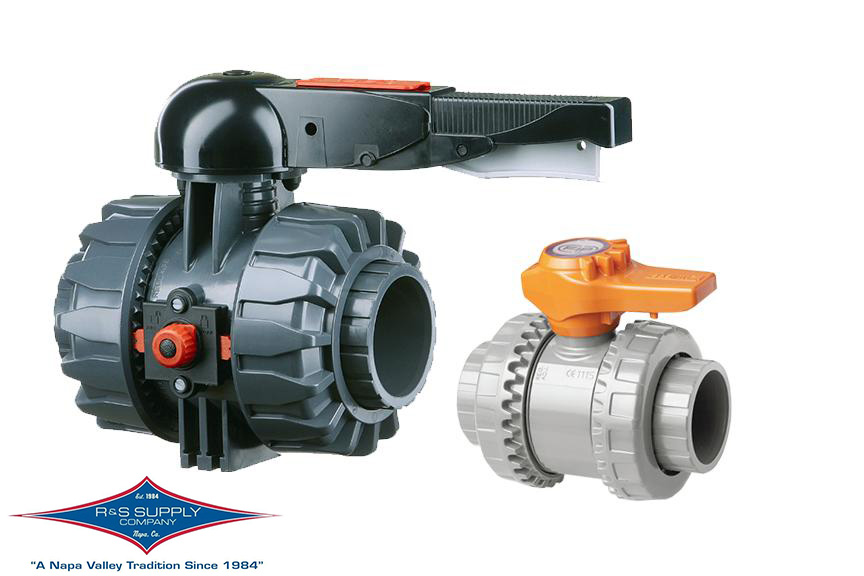
Another important consideration is the type of valve installed on your tote. Two common designs are ball valves and butterfly valves.
Ball Valves
Ball valves use a rotating ball with an opening through its center to control flow.
When the handle turns, the internal ball rotates to either align its opening with the flow path or block it.
They are commonly used for liquid transfer and general on/off control.
Butterfly Valves
Butterfly valves use a disc mounted on a rotating shaft. Turning the handle rotates the disc between open and closed positions.
These valves can offer compact construction and are used in many industrial liquid-handling applications.
Because the disc remains within the flow path, the flow characteristics differ from those of a full-port ball valve.
Can You Replace One Type with the Other?
Not automatically.
Although both valve styles control liquid discharge, switching from a butterfly valve to a ball valve requires verification of the complete assembly's dimensions, materials, connections, and container approval.
The correct replacement should be specified or approved for the particular IBC model.
How to Identify the Correct IBC Tote Replacement Valve
Before ordering a replacement, work through the following checklist.
IBC Valve Identification Checklist
- Identify the IBC manufacturer and model
- Locate the valve manufacturer or part number
- Confirm whether the complete valve is serviceable
- Identify the tank-side connection
- Measure the discharge outlet diameter
- Measure the thread pitch or threads per inch
- Identify the valve type and material
- Confirm gasket and seal compatibility
- Check applicable manufacturer replacement instructions
Step 1: Find the Manufacturer Information
Start by checking the tote's identification label, molded markings, and valve body.
Look for manufacturer names, model numbers, and any markings indicating the valve design or connection type.
This information is particularly useful when purchasing a complete valve assembly.
Step 2: Measure the Outlet Diameter
If the discharge outlet has external threads, use a caliper to measure across the outside of the threads.
For example, an S60x6 connection should measure approximately 60 mm.
A standard ruler can provide a rough measurement, but a caliper is more accurate.
Step 3: Check the Thread Pitch
Thread pitch is the distance between corresponding points on adjacent threads.
For coarse threads, measure the distance across several thread intervals and divide by the number of intervals.
For fine pipe threads, a thread pitch gauge can help determine the number of threads per inch.
Do not rely on outside diameter alone.
Step 4: Identify the Valve Style
Check whether the valve uses a rotating ball, butterfly disc, or another internal mechanism.
If the design isn't obvious, consult the manufacturer's technical information rather than disassembling an unknown valve.
Step 5: Confirm the Materials
The valve body, seats, and gaskets must be compatible with the liquid being stored or transferred.
For example, a gasket suitable for water may not be suitable for certain solvents, oils, or cleaning chemicals.
Always consult the chemical manufacturer's safety information and the valve manufacturer's material compatibility guidance.
Step 6: Verify the Replacement Part
Once you've collected the measurements and manufacturer information, compare them with the replacement valve's technical specifications.
If the valve is part of a certified IBC assembly, verify that replacement is permitted and that the component is approved for that container.
Choosing the Right Valve Material
The correct valve isn't just about size. Material compatibility can be equally important.
| Material | Common Considerations |
|---|---|
| Polypropylene (PP) | Used in many industrial valve bodies; chemical compatibility varies |
| Polyethylene (PE) | Common in container components; suitability depends on formulation and service |
| Stainless Steel | Used in industrial and sanitary systems; grade and corrosion resistance matter |
| EPDM | Elastomer used for certain water and chemical applications |
| FKM | Elastomer used in selected chemical and oil applications |
| PTFE | Fluoropolymer commonly used in valve seats and seals |
No material is universally compatible with every liquid.
For food and beverage operations, confirm that all wetted materials are suitable for the intended product and that applicable regulatory and sanitation requirements are met.
Common Mistakes When Replacing an IBC Tote Valve
Buying Based Only on a 2-Inch Description
A valve advertised as 2-inch may refer to its nominal bore, pipe connection, or another dimension. Always check the exact specifications.
Confusing Coarse and Fine Threads
S60x6 threads are much coarser than common 2-inch pipe threads. Connections that appear similar in diameter may not fit together.
Ignoring the Tank-Side Connection
An outlet adapter and a complete replacement valve are different products. A matching discharge outlet does not prove that the valve will fit the container.
Using the Wrong Gasket
An incorrectly sized or chemically incompatible gasket may leak, swell, degrade, or fail prematurely.
Overtightening Plastic Components
Excessive force can damage plastic threads and sealing surfaces. Follow the manufacturer's installation instructions rather than relying on guesswork.
Assuming Every IBC Valve Is Replaceable
Some IBC valves are factory-installed components that should only be replaced by qualified service providers using approved parts.
This is especially important for containers used to transport regulated hazardous materials.
When Should You Replace an IBC Valve?
A valve may need professional inspection or replacement when you notice:
- Persistent leakage from the valve body or stem.
- Cracked or visibly damaged valve components.
- Difficulty opening or closing the valve.
- Damaged sealing surfaces.
- Chemical degradation or material deterioration.
- Internal damage that prevents proper shutoff.
Before replacing the entire valve, determine whether the problem is actually caused by an outlet cap, gasket, adapter, or other replaceable accessory.
Safety reminder: Never attempt to service a valve while the container is under pressure or contains hazardous residual material. Follow the container manufacturer's safety and maintenance instructions.
Where to Find IBC Tote Valves and Accessories
Finding the right replacement starts with identifying the exact component you need.
Sometimes the solution is a replacement outlet cap or gasket. In other cases, you may need a compatible adapter, discharge fitting, or manufacturer-approved valve assembly.
At R&S Supply Company, we offer a selection of IBC tote accessories and liquid-handling components to help customers maintain their equipment and connect totes to compatible systems.
Whether you're working with agricultural liquids, industrial processing equipment, or beverage production systems, selecting the right connection can help prevent unnecessary downtime and purchasing mistakes.
Find the Right IBC Tote Connection
Explore IBC accessories, adapters, and valve-related components at R&S Supply Company. Have your valve measurements and manufacturer information ready before selecting a replacement.
Browse IBC Valves & Accessories →Frequently Asked Questions About IBC Tote Valve Sizes
Are all IBC tote valves the same size?
No. IBC totes use different nominal valve sizes, connection designs, and thread specifications. Always verify the exact container and valve model.
What is the most common IBC tote valve size?
DN50, commonly described as 2-inch, is widely used on standard liquid IBCs. However, the discharge thread and tank-side connection must still be identified.
What does S60x6 mean?
S60x6 identifies a coarse threaded connection with approximately 60 mm major diameter and 6 mm thread pitch.
Is a 2-inch IBC valve the same as a 2-inch NPT valve?
Not necessarily. A 2-inch nominal IBC valve may use S60x6 or another outlet connection, while 2-inch NPT specifies a tapered pipe-thread standard.
Can I replace an IBC butterfly valve with a ball valve?
Only if the manufacturer approves a compatible replacement assembly for the container. Similar outlet dimensions alone are not sufficient.
How do I know whether my IBC valve can be replaced?
Check the manufacturer's instructions and the container's design specifications. Some factory-installed valves must be serviced by qualified IBC reconditioners.
What measurements should I take before ordering?
Record the manufacturer and valve model, tank-side connection, outlet diameter, thread pitch, valve type, and sealing materials.
Can I use a replacement valve from another manufacturer?
Only when its compatibility and approval for the specific IBC assembly have been confirmed. Never assume interchangeability based on appearance.
Final Thoughts: Choose the Right IBC Valve the First Time
Replacing an IBC tote valve doesn't have to be confusing, but it does require more than matching a general size description.
Understanding the difference between nominal valve sizes, thread specifications, and tank-side connections can help you avoid ordering incompatible components.
Before purchasing a replacement, identify your tote manufacturer, measure the discharge outlet, confirm the valve design, and review the manufacturer's approved replacement procedures.
For many common connection problems, the correct adapter, gasket, or outlet accessory may be all you need.
Need help finding compatible IBC tote accessories? Visit R&S Supply Company to explore our range of liquid handling equipment, valves, fittings, and accessories.
Technical References & Further Reading
- Mauser Packaging Solutions — IBC Product Brochure. Manufacturer documentation covering IBC container configurations, valve types, and outlet connections. View manufacturer brochure.
- Mauser Packaging Solutions — IBC Closing Instructions. Manufacturer guidance on IBC closure systems, valve replacement, and approved components. Read closing instructions.
- R&S Supply Company — IBC Tote Valves. Product information and available outlet connection configurations. View IBC tote valves.
- R&S Supply Company — IBC Thread Identification Guide. Additional information on identifying common IBC valve threads. Read thread identification guide.
Technical specifications and replacement procedures vary by manufacturer and product model. Always confirm compatibility with the manufacturer's current documentation.